6th – 5th c. BC (c. 500?)
Hanno the Navigator
“King of the Carthaginians” according to the Periplus — probably a suffete or a magistrate of the city.
Sent by Carthage beyond the Pillars of Hercules, he sailed along the Atlantic coast of Africa to found cities there. His account, the Periplus, is the oldest record of the exploration of West Africa.
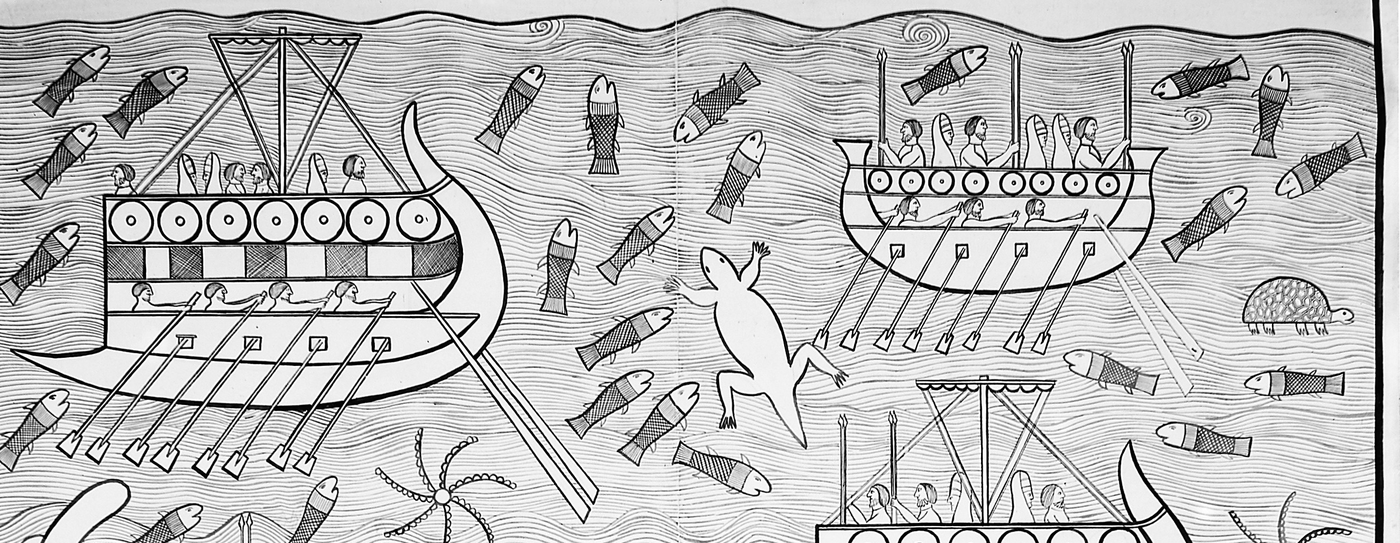
penteconters (50-oared ships)
men and women, according to the Periplus
cities founded on the Atlantic coast
“gorillas” captured, their skins brought to Carthage
The opening words of the Periplus« It pleased the Carthaginians that Hanno should sail beyond the Pillars of Hercules and found cities of Libyphoenicians. So he set sail with sixty penteconters and a multitude of men and women, about thirty thousand in number, with provisions and all other equipment. »
Periplus of Hanno, § 1
A unique text
The Periplus survives in Greek, in a single 9th-century Byzantine manuscript kept in Heidelberg. It presents itself as the translation of a Punic inscription that Hanno dedicated on his return in the temple of Kronos — that is, Baal Hammon — in Carthage.
Short (18 paragraphs) and dry as a ship’s log, it counts the days of sailing and names the places. It is one of the very few Carthaginian texts to survive, even indirectly.
The date of the expedition is uncertain: it is usually placed between the 6th and 5th centuries BC, when Carthage was organising its network of Atlantic trading posts.
Beyond the Pillars of Hercules
On the map
The voyages of Elissa, Hanno and Himilco. Beyond Morocco, Hanno’s route remains a hypothesis.
Approximate borders based on historical syntheses (spheres of influence, not modern borders). Base map: Natural Earth. Ancient sites: customary locations.
What Hanno saw
Cities of Libyphoenicians
Thirty thousand men and women: not a raid but a settlement venture. The new cities, peopled by Carthaginians and Africans, marked out the Atlantic route.
Elephants, crocodiles, hippos
The Periplus describes a lagoon where elephants graze, then a river teeming with crocodiles and hippopotamuses — often identified with the Senegal.
The “Chariot of the Gods”
A mountain of fire visible from the sea. Some see Mount Cameroon, an active volcano over 4,000 m high; others think of bush fires on the coastal hills.
The “gorillas”
« There were many savages; most were women with hairy bodies, whom our interpreters called gorillas. We could not catch the men; we took three women, who bit and scratched… We killed them and brought their skins back to Carthage. »
Periplus of Hanno, § 18
Were they chimpanzees, gorillas or baboons? No one knows. Pliny the Elder says the skins were displayed in the temple of Juno (Tanit) until Carthage fell in 146. In 1847 the naturalists Savage and Wyman borrowed the word from the Periplus to name the great ape of Central Africa: the gorilla.
How far did he go?
Historians have argued for centuries: the distances and names in the Periplus allow several readings.
As far as Cameroon
The Chariot of the Gods would be Mount Cameroon and the Southern Horn the far end of the Gulf of Guinea, or even Gabon. Hanno would have sailed more than 5,000 km beyond the strait.
Senegal, Sierra Leone
The Chretes would be the Senegal, the Chariot of the Gods Mount Kakoulima (Guinea) and the Southern Horn the coast of Sierra Leone. A frequently held view.
Atlantic Morocco
Some scholars limit the expedition to southern Morocco (Kerne = Mogador island, where a Phoenician trading post has been found) and consider the rest amplified, even embellished, by the Greek translator.
An account that crossed the centuries