Punic language and writing
Twenty-two consonants, written right to left: the alphabet brought from Phoenicia carried the language of Carthage for centuries — and it is the ancestor of ours.
Qrtḥdšt
Qart-hadasht, “the New City”: Carthage’s name as its people wrote it, without vowels.
letters, all consonants: the Phoenician alphabet
vowels written in classical Phoenician script
BC: the Nora Stone, 9th–8th c. (Sardinia), one of the oldest Phoenician inscriptions in the West
AD: Saint Augustine still hears Punic spoken in the countryside
The Phoenician alphabet
Each letter is named after a word that begins with it. The meanings of these names are traditional; some remain uncertain.
- 1ʾālepʾ · oxΑ · A · ا
- 2bētb · houseΒ · B · ب
- 3gīmlg · camelΓ · C, G · ج
- 4dāletd · doorΔ · D · د
- 5hēh · uncertainΕ · E · ه
- 6wāww · hookϜ, Υ · F, V, U, W, Y · و
- 7zayinz · weaponΖ · Z · ز
- 8ḥētḥ · fenceΗ · H · ح
- 9ṭētṭ · uncertainΘ · ط
- 10yōdy · handΙ · I, J · ي
- 11kapk · palmΚ · K · ك
- 12lāmedl · goadΛ · L · ل
- 13mēmm · waterΜ · M · م
- 14nūnn · fishΝ · N · ن
- 15sāmeks · supportΞ · س
- 16ʿayinʿ · eyeΟ · O · ع
- 17pēp · mouthΠ · P · ف
- 18ṣādēṣ · uncertainϺ · ص
- 19qōpq · uncertainϘ · Q · ق
- 20rēšr · headΡ · R · ر
- 21šīnš · toothΣ · S · ش
- 22tāwt · markΤ · T · ت
Under each letter: scholarly transliteration, traditional meaning of the name, then the Greek letter derived from it, the Latin letter descended from it (where there is one) and the corresponding Arabic letter. The old order of the Arabic alphabet — abjad, hawwaz, ḥuṭṭī… — still follows the Phoenician one.
Write your name in Phoenician
Type a first name (in Latin or Arabic letters): each sound is replaced by the closest Phoenician letter.
Letters: ḥēt, ʾālep, nūn, nūn, yōd, bēt, ʾālep, lāmed
- H → ḥēt
- A → ʾālep
- N → nūn
- N → nūn
- I → yōd
- B → bēt
- A → ʾālep
- L → lāmed
A playful approximation: the Phoenician alphabet had no vowels and some sounds did not exist (v, j…). The real Hannibal was written (Ḥnbʿl, “grace of Baal”), right to left.
From Phoenician to Punic, then Neo-Punic
“Ask our peasants what they are: they answer in Punic, ‘Chanani’.”
Augustine, Epistolae ad Romanos inchoata expositio, 13
The passage is often quoted as proof that Punic was still spoken and that its speakers called themselves “Canaanites”. But the text is rhetorical and the manuscripts differ; Gabriel Camps sees it rather as a Libyan dialect, since punicus often simply meant “African” at the time.
For Stéphane Gsell, and later M’hamed Hassine Fantar, the survival of a Semitic language in North Africa may have eased the Arabisation of the Maghreb centuries later.
What the stones say
With no books surviving, inscriptions are our main written source. They are numerous, but often short and repetitive.
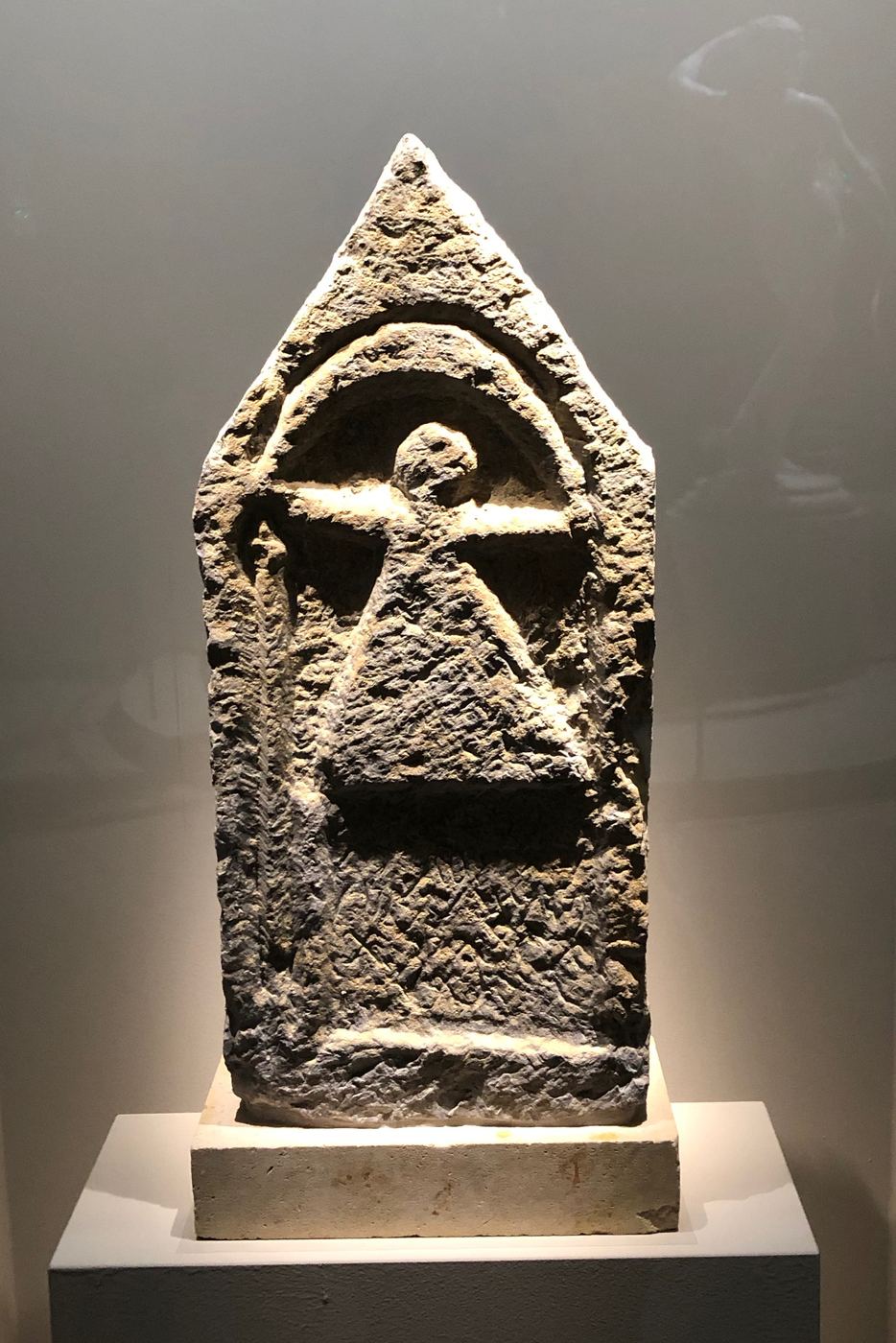
The tophet stelae
The tophets of Carthage and other cities have yielded thousands of them, gathered in the Corpus Inscriptionum Semiticarum. Their texts are highly formulaic: they tell little about the city’s history and give a limited number of personal names.
lrbt ltnt pn bʿl wlʾdn lbʿl ḥmn
“To the Lady Tanit, face of Baal, and to the Lord Baal Hammon”: the dedication formula that opens many of Carthage’s stelae.
On these gods and the debate over the tophet, see the religion page.
The Marseille Tariff
Found in the port of Marseille, this regulation sets, animal by animal, the share owed to the priests for each sacrifice. Specialists attribute it to Carthage.
The Pyrgi Tablets
Three gold sheets found in 1964 at the port of Caere: two in Etruscan, one in Phoenician. King Thefarie Velianas dedicates a holy place to Uni-Astarte.
The Dougga bilingual
On the Libyco-Punic mausoleum at Dougga, the same text in Punic and Libyan — a key to deciphering Libyan script. The block was torn out in 1842 by the British consul Thomas Reade.
Letters in metal
Coin legends, Punic then Numidian, are inscriptions too: they show how letter shapes varied from place to place and over time.
Libraries without books
Carthage had libraries, where Greek literature also circulated. People wrote on law, history and geography; Carthaginian philosophers are known from Diogenes Laertius and Iamblichus.
In 146, according to Pliny the Elder, the Roman Senate gave these libraries to the Numidian kings and had only Mago translated. Sallust says he consulted “Punic books” attributed to King Hiempsal; after that, their trail goes cold.
Fragments, through others
The alphabet that conquered the world
The Greeks borrowed the alphabet from the Phoenicians and added vowels. Through them, then the Etruscans and the Romans, it became ours.
Two great branches
- WestwardsPhoenicianGreekEtruscanLatinEuropean alphabets
- EastwardsPhoenicianAramaicNabataeanArabic
- AlsoAramaicSquare Hebrew
From ʾālep to A
| Phoenician | Greek | Latin |
|---|---|---|
| ʾālep | Α | A |
| bēt | Β | B |
| dālet | Δ | D |
| mēm | Μ | M |
| ʿayin | Ο | O |
| rēš | Ρ | R |
The Greeks recycled as vowels some consonants that did not exist in their language: ʾālep became alpha (A), ʿayin became omicron (O).