221
Keep the boy in Carthage
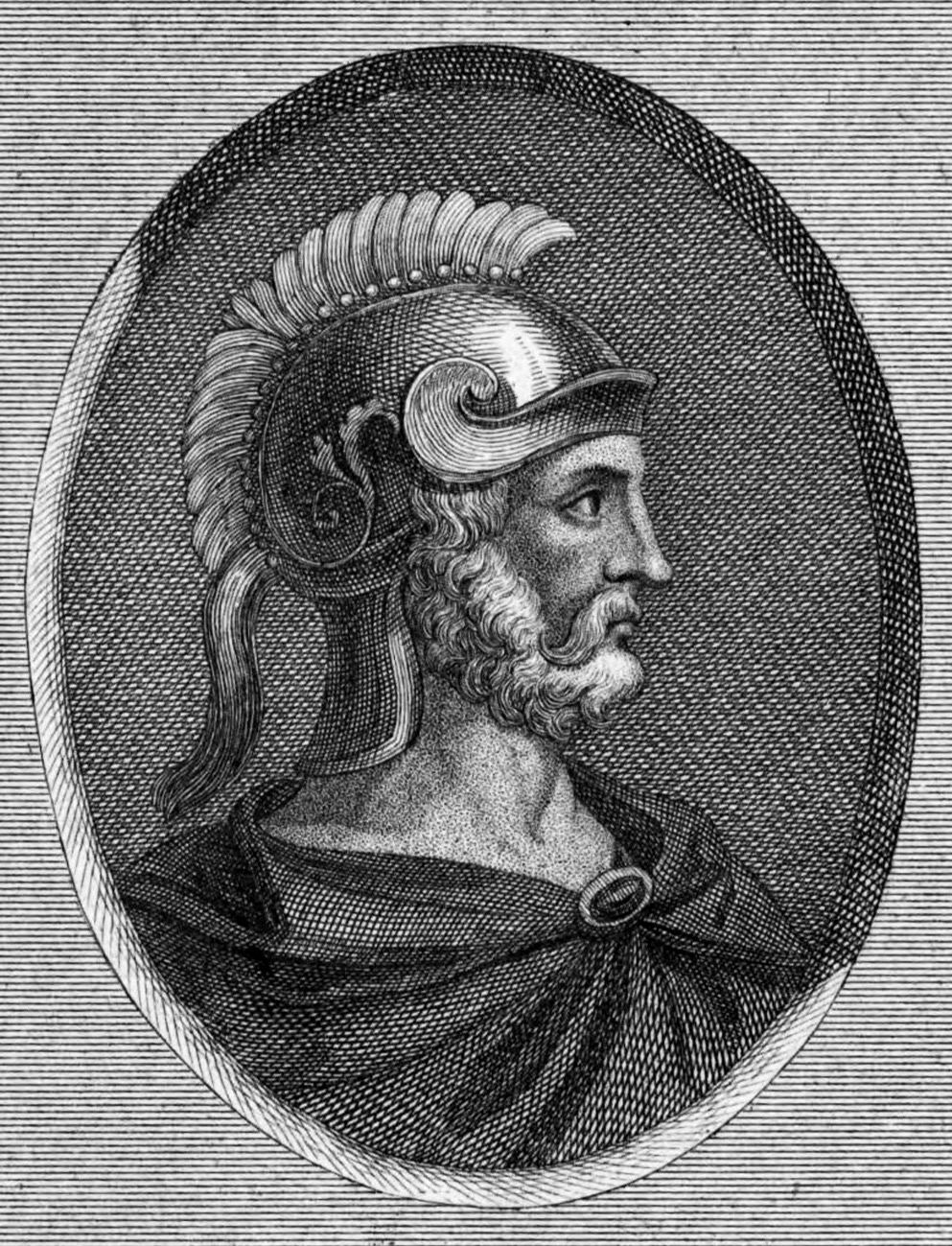
Hasdrubal the Fair asks for the young Hannibal. Hanno wants him to grow up under the laws of the city, not in a camp where he would learn to rule as a master.
Livy, XXI, 3
Active c. 247 – late 3rd c. BC
The man of Africa against the Barcas
Conqueror of the Libyan hinterland, unlucky general of the Mercenary War, rival of Hamilcar and open opponent of Hannibal: for the ancients, Hanno embodied the Carthage of the great landowners, which wanted peace with Rome.
capture of Hecatompylus, in the Libyan hinterland (Diodorus)
hostages taken at Hecatompylus, and the city spared (Diodorus, XXIV, 10)
elephants in his army before Utica, in 240 (Polybius, I, 74)
senators sent to reconcile him with Hamilcar (Polybius, I, 87)
His family and the dates of his birth and death are unknown. Hanno appears in the sources around 247, as Carthage's general in Africa, and vanishes after the Second Punic War. The nickname "the Great" distinguishes him from his many namesakes; the texts usually call him simply Hanno.
For Polybius as for Livy, he is the figurehead of a faction: the great landowners of the African chora, devoted to working the land and hostile to the Barcids' distant ventures. The institutions page of this site describes these rivalries.
In the 3rd century two visions clashed in the Senate; the sources embody them in two men.
Extend and exploit Libyan territory, the source of the landed aristocracy's income; avoid another war with Rome. Polybius recalls how harsh this policy was: during the First Punic War, Libyan farmers were made to hand over half their harvest (I, 72) — which explains why they joined the mercenaries.
Make up for the loss of Sicily with an empire in Iberia, rich in silver and soldiers, and prepare for revenge. Polybius (III, 8), reporting Fabius Pictor's view, describes the Barcids relying on popular favour; M. Sznycer rejects the notion of a Hellenistic-style monarchy.
The first general in charge of the war, Hanno was a good organiser, Polybius grants, but a poor field commander: he could raise an army, not seize the moment. His failure opened the way for Hamilcar.
He came to ask the soldiers to give up part of their pay. The misunderstanding turned into open revolt.
Victorious at the first clash thanks to his elephants, he went back into the city without pursuing; the rebels returned and seized his equipment.
His rivalry with Hamilcar paralysed the command: the army decided in favour of Hamilcar (Polybius, I, 82).
Reconciled by a Senate commission, he fought alongside Hamilcar against Mathos's last army, which was beaten and captured.
Et aequum postulare videtur Hasdrubal, et ego tamen non censeo quod petit tribuendum. […] Vereor ne quandoque parvus hic ignis incendium ingens exsuscitet.
« Hasdrubal's request seems fair, and yet I do not think what he asks should be granted. […] I fear that one day this little spark may kindle a vast fire. »
Three speeches reported by Livy: they tell us less what Hanno said than what Rome wanted to hear.
Hasdrubal the Fair asks for the young Hannibal. Hanno wants him to grow up under the laws of the city, not in a camp where he would learn to rule as a master.
Livy, XXI, 3
After Saguntum, he recalls the sworn peace, foretells a ruinous war and proposes handing Hannibal over to the Roman envoys. The Senate chooses war.
Livy, XXI, 10
Faced with the gold rings brought by Mago, he asks which Latin people has defected: none. Rome has not bent; now is the time to negotiate.
Livy, XXIII, 12–13
Livy is hostile to Hannibal: he makes Hanno the voice of reason, the one who foresaw everything. These speeches are literary reconstructions, written two centuries later, not minutes.
Polybius, closer to the events, is severe on Hanno the general. And the sharp contrast between a "Hanno party" and a "Barcid party" probably simplifies a political game of shifting alliances.
Leaving Italy in 203, Hannibal named Hanno among those who had denied him reinforcements. After Zama (202), the peace faction prevailed and the treaty of 201 was accepted.
Hanno, by then elderly, vanishes from the sources. Other Hannos appear in the accounts of 204–201 and 150–149: nothing allows us to say they are the same man.